Begin with something ordinary
Food, music, a photograph, or a telephone gives each scene a recognizable human objective.
Director's Vlog / Finished Original
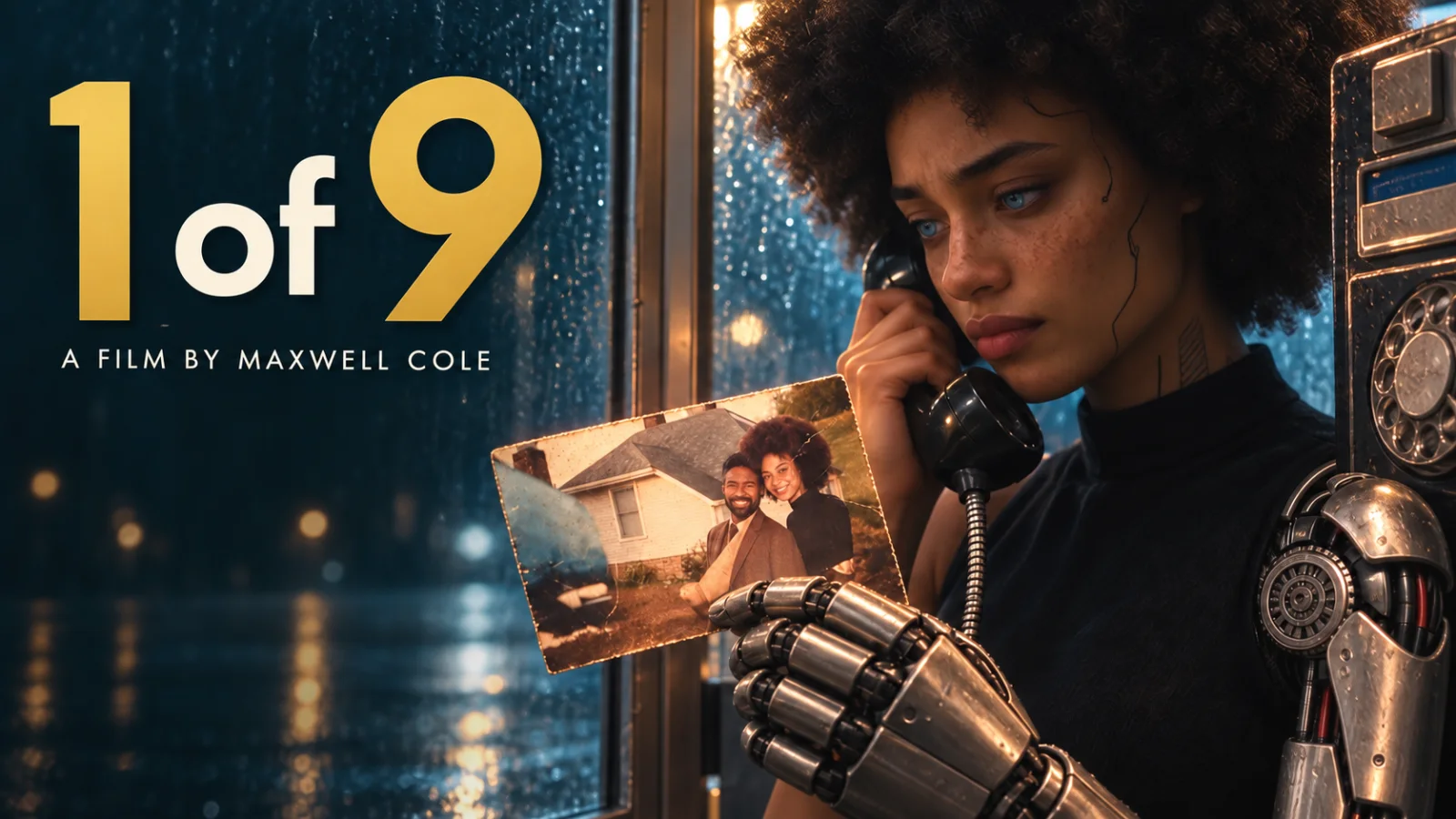
Back from the dead and branded dangerous, Penny crosses 1978 Pittsburgh to reach the husband who still believes she is dead.
1 OF 9 opens like a government warning and becomes a race toward home. Penny is the first of nine people revived through a classified bionics program. She has a photograph, a route, and one chance to reach the man who still thinks she is dead.
A complicated world becomes easy to enter when the audience can follow one clear emotional need. The same idea helps a commercial keep its character, product, tone, and message moving in the same direction.
01
Every encounter can expose her, trigger the body she is still learning to control, or pull her one step farther from home.
Her mechanical strength and amplified hearing create real danger. The direction stays close to her restraint, curiosity, and dry response to the people around her. Suspense and comedy come from the gap between what Penny does and what the city says she did.
Every public incident must reveal character, increase pressure, or move Penny closer to home. A striking moment does not remain in the film unless it changes what the audience understands.
02
Penny's objective never changes: follow the photograph, survive the attention, and reach the man who believes she is gone.
Food, music, a photograph, or a telephone gives each scene a recognizable human objective.
Strength, sound, and public attention turn a simple action into pressure without making Penny a superhero.
Each retained encounter adds information, consequence, or direction to the homecoming journey.
03
Streetcars, rain, radio reports, fluorescent interiors, and crowded rooms make every public space a risk. Warm household light marks the only place she wants to reach.
Penny's rounded afro, blue eyes, facial markings, black night wardrobe, human right arm, and exposed mechanical left arm remain controlled across the film. Locations use recognizable Pittsburgh textures and geography. Rain, streetcars, radio reports, fluorescent interiors, and warm household light make the world feel lived in rather than illustrated.
04
Every directing choice brings the audience closer to her while the city judges her from farther away.
Other people's fear creates the danger around her. Her restraint gives us space to study her behavior instead of accepting the label placed on her.
Her left arm needs to feel like part of one body, not an effect that changes from shot to shot. That consistency keeps our attention on Penny.
The photograph and the route through the city begin as clues. Their meaning grows until curiosity becomes emotional recognition.
Radio, weather, traffic, and transit guide Penny through the city, but sound also lets us experience how different the world feels inside her body.
05
The useful part of the process was not pretending the first good cut was the final cut. I isolated each problem, kept the approved material stable, and changed only what needed changing.
An early weather pass leaned on a repeated rain loop and a synthetic police tone. It called attention to the construction. I rebuilt it with two weather sections, restrained thunder, and location sound from the matching trolley and exterior footage.
Automatic ducking made the score pump against the voices. I removed it, used stable gain, and opened space in the midrange instead. The music could support Penny without announcing every line it survived.
Government-style effects crowded the title sequence. I removed them and let the opening breathe. The warning cards carried more authority without another sound telling the audience how official they were.
A television-like doorway artifact and an unstable Bingo transition remained inside otherwise approved scenes. I repaired those brief intervals without rebuilding the surrounding edit, dialogue timing, or soundtrack.
Revision should be surgical. I preserve an approved master, isolate the failure, test the smallest useful change, and keep a rollback. “Regenerate everything” is not a finishing strategy.
06
The film was finished when every scene sharpened Penny's objective, increased the pressure, or made the homecoming hit harder.
Give Penny one clear need, then let every encounter bring her closer to it or make the journey harder.
Hold onto the face, body, wardrobe, places, and small details that make her feel like the same person throughout the film.
Remove anything that does not serve the story. Let performance, timing, and the move between scenes guide the film.
Use music, radio, weather, physical sound, captions, and the final image to complete the emotional journey.
The finished 6:18 film is on the Max Cole Films YouTube channel. Watch it at the top of this page, then follow the director's vlog to see how the story, character, visual world, edit, and sound came together.
Work directly with Maxwell from concept through delivery
Send the audience, message, launch date, and required placements. I will identify the emotional idea, visual system, and production path before building the campaign.
Start a project